Es Vedrà
Back to all places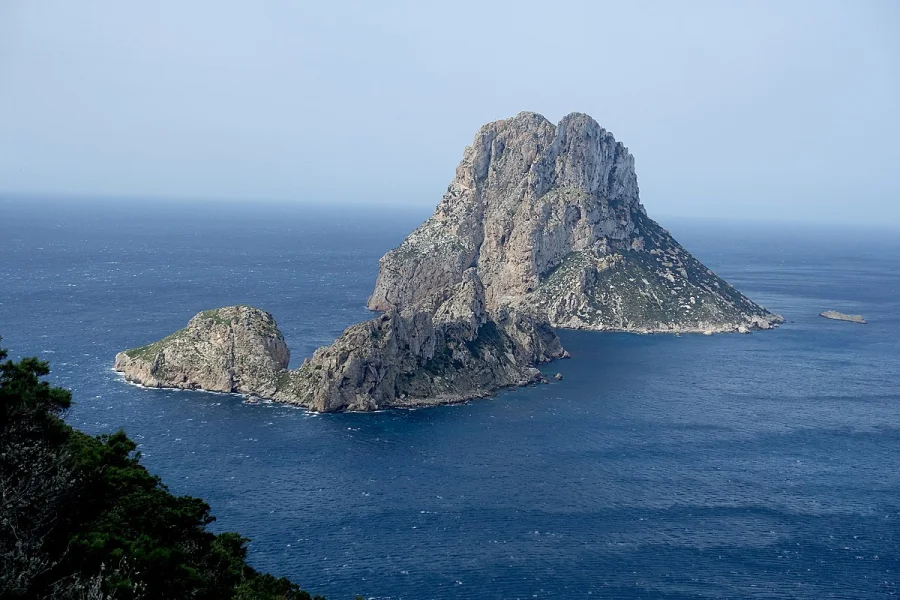
Rising dramatically from the Mediterranean Sea off the southwestern coast of Ibiza, Es Vedrà is a majestic rocky islet shrouded in legend and history. Measuring approximately 413 meters at its highest point, this limestone monolith is a protected natural reserve, renowned not only for its striking appearance but also for its profound ecological and cultural significance. Throughout the centuries, Es Vedrà has been enveloped in mystery. Phoenician settlers are said to have considered the island sacred around 654 BC, dedicating nearby temples to the goddess Tanit, whose association with the moon and fertility lingered in local lore. In the 18th century, the hermit friar Francis Palau y Quer, exiled to Ibiza by the Spanish government, lived and meditated on Es Vedrà, where he claimed to experience spiritual visions—his reflections were later chronicled in his mystical writings. This period firmly established the islet’s reputation as a place of spiritual energy. Numerous legends suggest that Es Vedrà is the fabled island of the sirens mentioned in Homer’s “Odyssey,” luring Ulysses and his crew. Over the centuries, the island has also been reputed to possess powerful magnetic qualities, with stories of navigation instruments faltering in its presence, earning it comparison to the Bermuda Triangle. During the Spanish Civil War (1936-1939), the surrounding waters were monitored for strategic purposes due to Es Vedrà’s vantage point, serving as a silent witness to various military operations in the region. In recent times, Es Vedrà has become a symbol of the Balearic Islands, valued for its diverse flora and as a refuge for endangered species, with conservation efforts protecting its unique biodiversity. Its unparalleled silhouette and legendary status attract historians, scientists, and travelers alike, making Es Vedrà not only a marvel of nature but also a living monument to the enduring intrigue of Mediterranean history.
38.86782, 1.19877